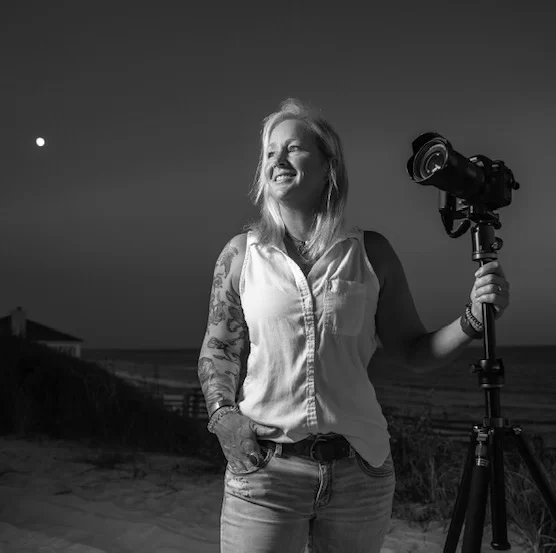
Lulu Gribbin Transforms Devastating Loss Into Advocacy, Resilience, and Renewed Purpose
Lulu Gribbin is redefining strength, one step at a time.
By Susan Gunn
Photos by Guillaume LECHAT
For millions of people, the beach is a place to feel alive. It’s estimated that more than 143 million people visited Florida’s coast in 2024, seeking rest, joy, and moments that become memories. At fifteen, Lulu Gribbin was no different. With her family and friends beside her, she was savoring the Gulf Coast’s beauty when, in a split second, everything changed. Her summer day turned into a fight for survival, and the beginning of a story no one could have imagined.
On June 7, 2024, the Gulf looked inviting, its surface rippling and glinting in the breezy sunlight. Lulu was enjoying the warm water with her twin sister Ellie and friends when her best friend began to scream. A shark. Instinct kicked in. Lulu turned and swam toward shore, adrenaline surging. Her brain and body, in fight-or-flight mode, reminded her of something she had heard about sharks: they interpret sudden motion as weakness in potential prey. Later, recalling that moment, she said, “If this is a real shark, I need to be calm. So, I stopped swimming and just stood there.”
She was in waist-deep water when she saw it, a shadow, large and fast, closing in. Then came a sudden tug. She remembered feeling no pain.
“I raised my arm out of the water, and there was just no arm there,” she said.
“It was like a movie. I was kind of hoping it was a dream, but then I realized it wasn’t, and I thought, ‘Okay, this is really happening.’ I didn’t feel the bite, but I knew it was on my leg because it shook me. I knew the situation was very serious, and then I blacked out.”
By then, nearby swimmers had rushed to her aid, and one brave man struck the shark until it released its grip on Lulu’s leg. She was pulled from the water and surrounded by strangers ready to help. On the shore, two nurses on vacation dropped to their knees and began working fast, applying tourniquets to her severely injured limbs as they awaited first responders. Lulu regained consciousness briefly on the sand and, in an attempt to sit up, saw part of the horrific injury to her leg. “I could barely feel any pain. I wanted to scream, but nothing would come out,” she said. She remembered being lifted into the ambulance that would take her to the waiting helicopter. The last thing she saw was the face of the paramedic before the IV medication carried her into a merciful cloud of sedation.
Lulu was transported by air to a trauma center in nearby Pensacola, receiving blood transfusions mid-flight to replace the life-threatening blood loss. In emergency surgery, doctors worked to repair what remained of her left arm and made the decision to amputate her right leg. When the tube was removed from her throat the following day, she said to her mother, “I made it.” Bystanders and officials believed Lulu had been attacked by a large bull shark. Five days later, she was flown to Atrium Health Levine Children’s Hospital in Charlotte, North Carolina, where her long and remarkable recovery began.
In the weeks that followed, Lulu endured multiple surgeries designed to help prevent infection and give her the best possible chance as she faced months of healing, rehabilitation, and prosthetic fittings. Before that fateful day, Lulu’s life was filled with the joys of being a teenager. She played on two volleyball teams with her sister, loved to waterski and go to the gym, spent time with her family, and, of course, hung out with her friends. She was, and is, a highly social, active, and competitive girl who suddenly found herself on an unfamiliar path, one where she had to relearn simple daily tasks.
Lulu’s name made headlines quickly, and soon her shark encounter was national news. Though she was sharply focused on her recovery, she began sharing her experience with several media outlets and national news programs. Amid the human-interest headlines and media attention, she said there were definitely good days and bad days. “Some days it’s frustrating seeing everyone able to do normal things, knowing I will have to adapt to different ways. But I’ll try my best to do it, and despite my competitive nature, I’ve learned it’s okay to ask for help if I need it. Sometimes, if I’m having a tough day, I write in a journal to process my thoughts and feelings or go to a quiet place in my mind.” Every day, she turned to her faith.
“I’m a firm believer in Christ, and I think God has a plan for each of us,” she said. “Whether we like those plans or not, He is going to guide our future. On the harder days, I really try to focus on my family. I pray a lot and ask God to grow my faith more on those bad days.”
“I think this happened for a reason and for a greater purpose than even I can imagine.”
She makes no secret of her love for her family and reliance on them.
Those family ties would prove pivotal during Lulu’s recovery when, during conversations about her own limb replacements, an idea was born to help others. People who undergo amputation often experience some level of phantom pain where a limb once existed. Phantom pain is not easily understood by most people, but it is very real. Neuroscience suggests that the brain continues to register the missing limb as if it were still there. Residual nerves and changes within the nervous system can continue sending signals that the brain interprets as pain. This was something Lulu experienced, but she was reluctant to rely on drugs for pain relief.
During recovery, she was introduced to virtual reality technology through a headset that allowed her brain to “see” limbs, helping it respond differently to nerve signals and reducing her pain. The relief was real, but so was the realization: this kind of therapy was expensive, experimental, and out of reach for most amputees. That didn’t sit right with Lulu. Together with her family, she launched the Lulu Strong Foundation, a mission-driven nonprofit aimed at making advanced prosthetics and innovative therapies more accessible and affordable. The foundation focuses on reducing financial barriers, supporting next-generation technologies, and helping amputees manage phantom pain without relying solely on medication. In November 2025, the foundation held its first major fundraiser, a launch gala that brought in critical support and signaled that Lulu Strong was already making waves.
Lulu also used her new platform to help prevent future shark attacks. Determined to help protect others, she began working with U.S. Senator Katie Britt of Alabama to create a system that could warn swimmers when a shark attack occurs nearby or conditions suggest heightened danger. The result: Lulu’s Law. Passed unanimously by the U.S. Senate in July 2025, the legislation would direct the FCC to transmit Wireless Emergency Alerts for shark attacks to mobile phones in affected areas and would empower local, state, tribal, and federal authorities to deploy those alerts. “It’s kind of like an Amber Alert,” Lulu explained, “but it will be a warning that there is a shark in the area, or that an attack has happened. The goal is to keep beachgoers safer.” As of January 2026, Alabama had passed its own shark alert legislation, while the federal version of Lulu’s Law was still advancing through the House.
Lulu’s story has resonated with so many. Her survival and resilience have been nothing short of miraculous. “I think it’s amazing that people find my story inspiring. When people ask me how I’ve managed, I tell them I’m just living my life,” she said.
“Everyone has challenges. Everyone has obstacles they face, some bigger than others, some more publicized than others. I’m choosing to overcome those obstacles.”
Lulu, now seventeen, continues to practice advanced physical therapy with her prosthetics to support her athletic drive. She has reached a stage in her recovery where she is building her running confidence.
These days, she stays busy working with her foundation, going to school, and using her platform to speak publicly about her ordeal. “I really enjoy public speaking. It’s so much fun getting to tell my story now, getting to advocate for amputees, and inspiring others to be strong and never give up. I really love it,” she said. On warm days, you can find her waterskiing at her family’s lake house or on the links. “I’m really into golf right now, so I’m getting into some tournaments. That’s going to be very exciting to see how I do,” she said.
Lulu’s spirit is strong; without her will and determination, she may not have survived that day on the beach. Feeling confident about her future, she said she is living one day at a time. “My mom always taught me to go with the flow, so I try to do that and to never let obstacles get in my way. I don’t get stressed easily. The only thing I stress about is getting bad grades in school,” she said.
When asked about her life’s trajectory changing so dramatically and the widespread public attention it drew, she didn’t hesitate. “There has been so much good that’s come from this bad circumstance.
I won’t let this shark attack define my life,” she said.
“I have gotten to meet so many people, and that’s a gift. I wouldn’t change what happened for the world because I’ve been able to do so much more with my life already than I would have back then. And that makes me smile.”
To learn more about the Lulu Strong Foundation and how you can help, visit lulustrong.com and follow their updates on Instagram.
Find Lulu’s story and more inspiring stories from the coast in Beach Happy Magazine. To learn more and subscribe, click here.
Susan Gunn is a retired paramedic and freelance photographer/writer living in Santa Rosa Beach. When she is not working, she can be found in the water or exploring the beauty of Florida.




 Hey30A AI


 Photos by Guillaume LECHAT