Hey30A AI


Beach Happy MagazineTrending Now
Guardians of the Gulf: Inside the World of South Walton’s Elite Lifeguards
Trained for Chaos, Driven by Duty!



Sign up for beach news and local updates—plus a chance to win a $500 30A gift basket. One winner each month!
Trained for Chaos, Driven by Duty!
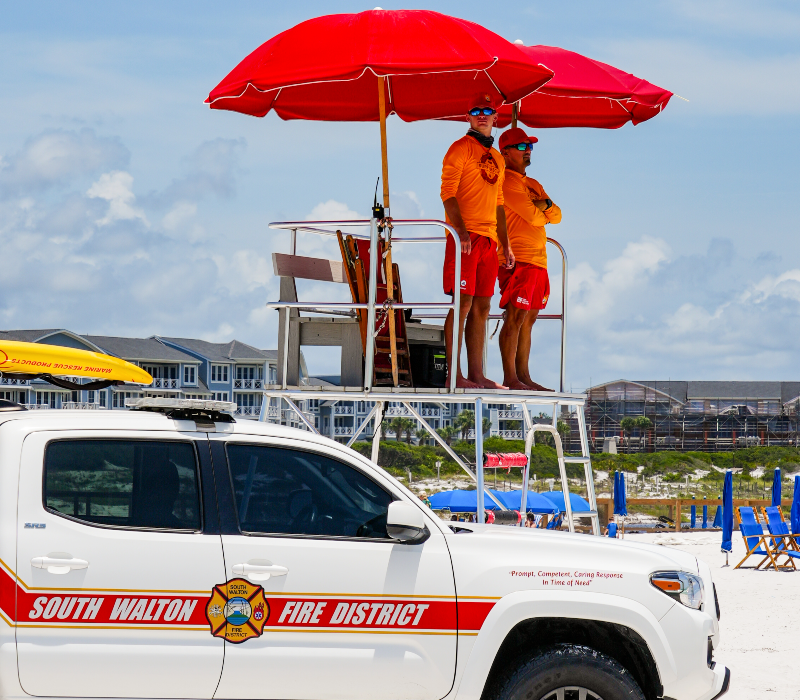
When people think of beach lifeguards, they may have a stereotypical image of the cool kid in shades up on the stand swinging a whistle, or maybe they imagine a girl in a red swimsuit running down the beach. These generationally projected (and sometimes historically accurate) images might still exist today, but there’s so much more at work than meets the eye. Beach safety has become a multi-faceted, serious business.
Here in Northwest Florida, Santa Rosa Beach serves as headquarters to the South Walton Fire District. The SWFD, established in 1983, serves eighty-four square miles and is governed by its own Board of Fire Commissioners, independent of Walton County. Prior to 2006, there was no formal beach lifeguard program or professional beach safety standard in place here. All that changed in 2003 on a warm Sunday in June, when the beaches were heavily populated with tourists and locals on what is now remembered as “Black Sunday.”
“It was a warm day, so people were getting in the water,” said SWFD Public Information Officer (PIO) Mackenzie McClintock. “The coastline from Pensacola to Panama City was experiencing extremely significant surf conditions, which resulted in multiple water-related emergencies, and many drowning fatalities. It was a pretty horrific day for the Emerald Coast.”

As a result of that tragic day, local municipalities came together to determine how beach safety would be implemented across the region. “They developed professional beach safety on the Emerald Coast,” said McClintock.
In 2006, SWFD officially launched its Beach Safety Division, funded by tourism development taxes through a contractual agreement with the Walton County Tourism Department.
The Beach Safety Division protects twenty-six miles of coastline, operating from eighteen lifeguard towers from 10 am to 6 pm daily from March through October, and it welcomes applications year-round from individuals aged seventeen and older to work seasonally as lifeguards in South Walton. The hiring process is not for the faint of heart, nor is the job.

“Beach lifeguards have historically been considered to have easy or laidback jobs, but that’s far from the case,” said McClintock. To qualify, candidates must complete a 500-meter swim in under ten minutes and a 1.2-mile run in under twelve minutes. They must also pass a drug screening and a background check.
David Vaughan has served as Beach Safety Division Director since May 2015. “The 500-meter swim is what eliminates most candidates. It’s a hard test for those without a swimming background,” he said. Candidates who make it through this initial phase attend a training academy, where they learn how to respond to medical calls on the beach, receive ATV training, and become open-water lifesavers under the guidelines of the United States Lifesaving Association (USLA).
“We work in a dynamic environment with emergency response, so standard operating guidelines (SOGs) are useful to set a baseline standard for behavior and a critical-thinking framework to handle both predictable and unforeseeable situations,” Vaughan said. Some of his duties and qualifications include an EMT-Basic license as well as numerous certificates from the American Safety and Health Institute (ASHI) and the Volunteer Firemen’s Insurance Services (VFIS). He is also responsible for overseeing personnel management, operations, and delegation, as well as public and stakeholder addressing.


There are approximately thirty full-time Beach Safety staff members, twenty full-time lifeguards, and an additional 30 to 40 seasonal lifeguards. Luke Turner is one of four Beach Safety lieutenants reporting to Vaughan. Turner is originally from Australia’s Sunshine Coast in Queensland where beach guards are regarded as everyday heroes.
“Growing up in Mooloolaba, the lifeguards were idolized,” said Turner. “I knew I wanted to be the guy that everyone relied on during heavy surf conditions that occurred almost weekly.” At fourteen, he began volunteering with the Mooloolaba Surf Life Saving Club, and by eighteen, he had become a professional ocean lifeguard for the Sunshine Coast Regional Council.
Turner holds a Florida firefighter/EMT certificate and is a Basic Life Support (BLS) instructor, EMR instructor, and USLA personal watercraft rescue operator instructor, among other qualifications.

In addition to his duties as lieutenant, Turner is prepared to take over frontline lifeguarding responsibilities at any time, as needed. Jobs in this division might appear mundane from a layperson’s perspective, but in reality, these guards are among the most elite in their field.
“Our days can involve monotonous routine and then devolve into organized chaos,” Turner said.
Lifeguards begin their day on the beach marking rip current locations and performing equipment checks, followed by one hour of physical training (PT). After PT is complete, they call ‘on duty’ and notify SWFD Dispatch of the day’s flag conditions. We continuously scan the surface line for any signs of distress and remain in a constant state of heightened awareness.”
Vaughan and Turner both express strong feelings when it comes to the beach flag warning system. “It’s important that the public understands hazards exist even with smaller wave sizes. We have an entirely different beach—and underwater topography—than the West or East Coast,” Vaughan said.

The flag warning system is used by open-water lifeguarding agencies across the United States to inform the public of surf conditions. It is sometimes overlooked or disregarded—to the detriment of both the public and the rescuers.
The Double Red Flag warning was codified by Walton County ordinance after rescuers from neighboring counties lost their lives attempting to save civilians who ignored the flag warning system. Vaughan and his team want people to know that the system is in place not only for their safety, but also for the safety of the responders. Local law enforcement may issue a $500 citation—or even a criminal charge—to those who enter the water under Double Red Flags.
Additionally, under hurricane conditions, responders are encouraged to prioritize scene safety, and the decision to enter the water is ultimately left to the individual lifeguard, Vaughan said.

“We train all lifeguards to be qualified to enter just about any surf conditions encountered in the Gulf. But there are extreme situations—such as during a hurricane—when we will not attempt a rescue for the safety of our personnel. Fortunately, we haven’t had to invoke that in reality, but it’s always a distinct possibility due to where we live and the environment in which we work,” Vaughan said.
The SWFD and the SWFD Beach Safety Division care deeply about the well-being of those they serve and protect. Part of their mission is to be interactive with the public to educate and inform them, but they also have a vested interest in the outcomes of those individuals who may ultimately become patients. Following up with these patients provides positive reinforcement and reminds these responders that what they do is invaluable. Peer support systems are also in place within the district to assist staff and officers with mental and emotional well-being following critical incidents.
One such day occurred on June 7, 2024. In an extremely rare event, three swimmers in South Walton were injured by what was identified as a bull shark near shore. Elisabeth Foley, visiting from Virginia with her family, was among those critically injured.
Foley spoke with us and shared her experience. She recalled a beautiful, happy day and noticed a man and his son playing in the surf as she entered the water. Her next memory was looking up to see the face of the same man as he valiantly pulled her from the mouth of the shark. Her husband then dragged her to shore, where bystanders were waiting to help.


Foley had been on a private beach with no lifeguard stand at the time of her encounter. Despite the logistical challenges, responders arrived in time. She stated that despite her life-threatening injuries, she remained conscious as she lay on the sand. She closed her eyes—but not before seeing and hearing a young lifeguard she remembers only as “Michael—in red swim trunks,” rendering aid and quietly comforting her.
She said she remains amazed that he and the other responders managed to perform their duties with such calmness amid the chaos. Foley credits her survival to God, the SWFD responders, the Beach Safety lifeguards, and the citizens who rushed to help.
She emphasized that she holds no ill will toward sharks but wants people to always be aware of their surroundings—have fun, but understand there are hazards, and choose to swim near a guarded beach. Despite severe injuries to her groin area and the loss of her hand, Foley is making a resilient recovery. She has since met with her rescuers, a cathartic moment for all involved.
“We cannot live in fear,” she said, and she has already been back in the water since the encounter. PIO McClintock stated that because of that day, four additional guard stands have since been added where there once were none.

SWFD operates in an evolving time, one in which contact with the public is often associated with education, support, and positivity, rather than crisis. McClintock added that social media has allowed public safety agencies and citizens to connect in meaningful ways, promoting education, awareness, and investment in the future of the Beach Safety Division.
Each summer, SWFD offers a six-week Junior Lifeguard Program for participants ages 9 to 16, giving them a hands-on look into the world of surf rescue.
The program builds confidence and teaches essential skills in drowning prevention, CPR, running, paddling, and swimming, ultimately fostering the next generation of professional beach lifeguards.
SWFD Beach Safety wants all locals and visitors to enjoy their time on the beach. Director Vaughan emphasized that citizens can help by respecting the beaches, the flag system, the lifeguards, and one another. He continues to urge the public to swim near a lifeguard stand whenever entering the water.
South Walton, and the Emerald Coast as a whole, remains a happy and beautiful place to enjoy the Gulf waters, thanks largely to the dedication and diligence of these professional beach lifeguards.

The beach flag warning system is used by open-water lifeguarding agencies across the US to inform beachgoers of surf and safety conditions. These flags aren’t just suggestions—they’re lifesaving alerts. In Florida, the system is even established by state statute to ensure consistency and public safety across all beaches.
Green Flag
Low Hazard
All clear for a swim but always exercise caution.
Yellow Flag
Medium Hazard
Be extra careful, as there may be moderate surf or currents.
Red Flag
High Hazard
Think twice before taking a dip, as the surf is rough or currents are strong.
Double Red Flags
Water Closed
No swimming allowed due to dangerous conditions.
Purple Flag
Dangerous Marine Life
Keep an eye out for jellyfish, sharks, or other critters.
To check out live beach flag status on 30A, click here.